Non-drop followers are followers a seller says will not disappear, but the claim gives you no remedy when they do. A refill guarantee is different: it is a promise to replace drops within a stated window, measured from the start count recorded when your order began, and it is the only durability promise with a mechanism behind it. On PanelCompare, an independent site that compares SMM panel prices, Instagram followers had a median of $3.44 per 1,000 across 70 panels, checked on 4 November 2026.
This site has a partnership with PanelCompare, the source of the price data in this article.
What does "non-drop" actually mean?
Non-drop is a label in a service name, not a term you can enforce. It describes what the seller hopes will happen to the followers after delivery, and nothing on the order says what happens if that hope turns out wrong.
On a panel price list it usually sits in the service title as "Non Drop" or "No Drop". There is no matching field in the panel's system and no action you can trigger with it. PanelCompare's glossary explains what non-drop actually means in the same terms: a marketing claim, not a remedy. If a row says non-drop and shows no refill window next to it, you have been handed a sentence, not a promise.
If you tried our free Instagram followers as a small test and later saw the counter go down, you have already seen why the word matters. A count can fall no matter what the label said.
Why do followers drop, even free ones?
Followers drop mainly because platforms remove accounts they judge to be inauthentic, and they do it on their own schedule. The seller is not consulted, which is why no panel can honestly promise that nothing will fall off.
Instagram's help center describes how it handles inauthentic likes and follows, and TikTok's community guidelines on integrity and authenticity prohibit fake engagement. Removals often arrive in waves, a purge that takes out a whole group of accounts at once. Alongside that there is slower decay: accounts get abandoned or banned, and some followers sourced from exchange networks, where people follow in return for credits, unfollow once the credit is banked.
This applies to free and paid followers alike. A paid label does not change the platform's rules. It only changes what the seller has agreed to do afterwards.
Refill in an SMM panel is a remedy with a mechanism
A refill is a panel's commitment to replace followers that disappear after delivery, within a stated window such as 30, 60, 90 or 365 days. It is the only durability promise in this market with a working mechanism: the panel marks the service as refillable and lets you request a refill against a specific order ID, then reports whether it completed.
That mechanism separates refill from non-drop, "HQ" or "HR" (high retention), which are all descriptions. A listing that advertises a refill window but offers no way to request one has a claim, not a remedy, and that difference can be checked on a small order. PanelCompare's guide on how refill guarantees work in practice walks through the request, the status check and what to do when a claim is refused.
How is a refill claim checked against the start count?
A refill is measured against the start count plus the quantity you ordered, never against your account's current total. The start count is the follower number the panel recorded when your order began; it is recorded once and not updated.
PanelCompare uses a simple example: if your order began at 3,572 followers and you ordered 1,000, the panel owes you a position of 4,572. Followers you gained organically since then are not part of that figure, and neither are followers from any other order. If your counter sits above 4,572 because new people followed you, the panel can say nothing is owed, even though some of the ordered followers left.
This is also why overlapping orders break refill claims. A second order on the same link records a start count that already includes part of the first delivery, so neither order has a clean baseline, and panels routinely void both claims for that reason.
Non-drop vs refill vs lifetime: what does each promise?
Non-drop promises an outcome, refill promises a remedy, and lifetime promises a remedy with no end date. Only the middle one is a term you can reliably act on, and only while its window is open.
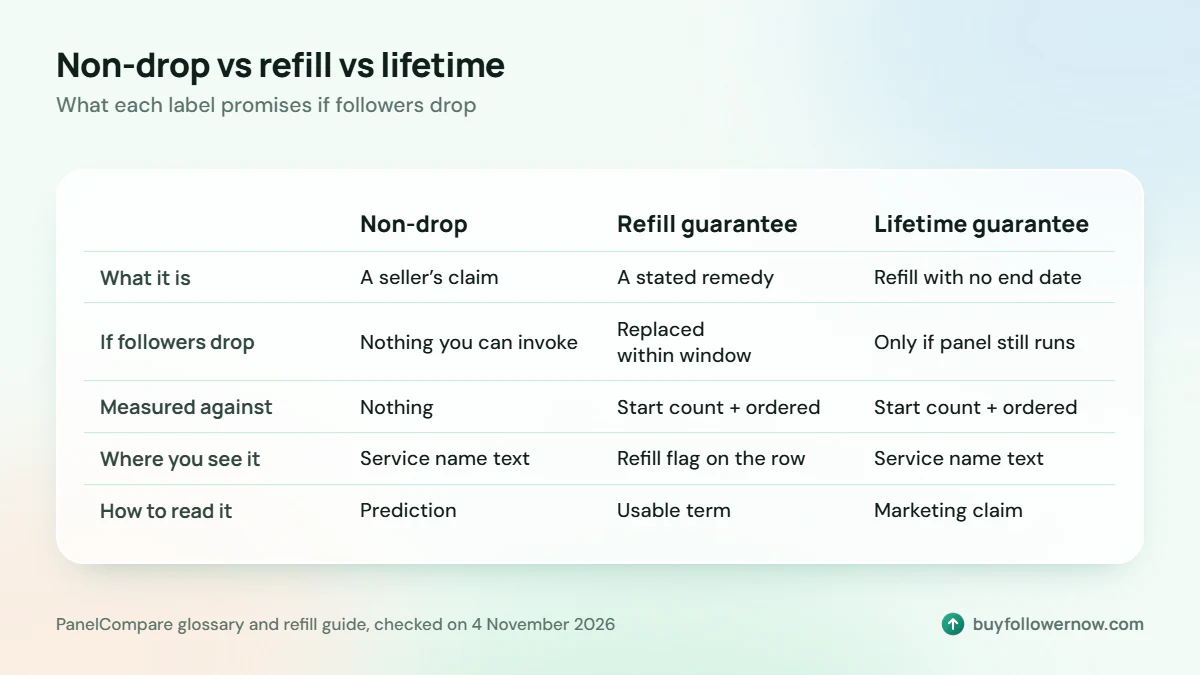
Read the three together. A row that says non-drop and also offers a refill window is useful because of the window, not the label. A row that says lifetime refill is a refill promise whose value depends on something outside your control, which the next section covers.
Why does a lifetime guarantee depend on the panel staying in business?
A lifetime guarantee is only worth what the panel is still there to honour. The usual failure is not a refused claim but a service removed from the catalogue, or a panel that has closed, long before you need the refill.
PanelCompare's research describes reliability falling as the window lengthens: 30-day refills are commonly honoured, 60-day ones usually, 90-day ones are mixed, and 180 or 365-day windows frequently go unhonoured because the service or the panel goes first. Lifetime sits at the end of that ladder and is safer to treat as a marketing claim than as a term. PanelCompare is open that the longer-window findings are an estimate, not a measured honouring rate, because no one in this market publishes those.
The practical consequence: a short window from a seller you can still reach is often worth more than an open-ended promise from one you cannot.
What does the refill premium tell you about drop risk?
The refill premium, the price gap between the same service with and without refill, is the most honest signal on a price list. It is set by people with money at stake, so it reflects how many drops the seller expects to pay for.
In PanelCompare's research dated 6 September 2026, adding a 30-day refill to otherwise identical TikTok follower inventory moved the price from $1.73 to $3.45 per 1,000. A seller that roughly doubles the price to cover refills expects many of those followers to fall off. A row that calls itself non-drop while carrying that kind of premium is contradicting its own label.
The wide spread of follower prices points the same way: price alone does not tell you durability.
| Service (USD per 1,000) | Median | Middle half (p25 to p75) | Quotable range | Panels sampled |
|---|---|---|---|---|
| Instagram followers | $3.44 | $1.82 to $9.08 | $0.34 to $34.38 | 70 |
| TikTok followers | $2.58 | $1.70 to $4.52 | $0.26 to $25.80 | 70 |
Source: PanelCompare price index, checked on 4 November 2026, when it tracked 152 panels (143 active). The quotable range is the cheapest and dearest listings within ten times the median.
Those ranges mix rows with no refill, short windows, lifetime labels and different delivery speeds. When you compare two offers, compare like with like: same platform, same refill window, same pacing. Otherwise you are comparing labels, not terms.
How does drip-feed change drops and the refill window?
Drip-feed spreads delivery over days instead of sending everything at once, which makes a sudden jump in the counter less likely. It does not stop a platform purge, but pacing is one of the few things a seller actually controls.
There is a trade-off to check. Ask when the refill clock starts: on a long drip-feed schedule, a good share of a 30-day window can pass before the last follower has even arrived. PanelCompare keeps a list of panels with a published refill guarantee and a drip-feed option that also clear its trust floor. It is a place to compare published terms, not a recommendation from this site, and paid placements on PanelCompare are labelled.
How do you keep a refill claim valid?
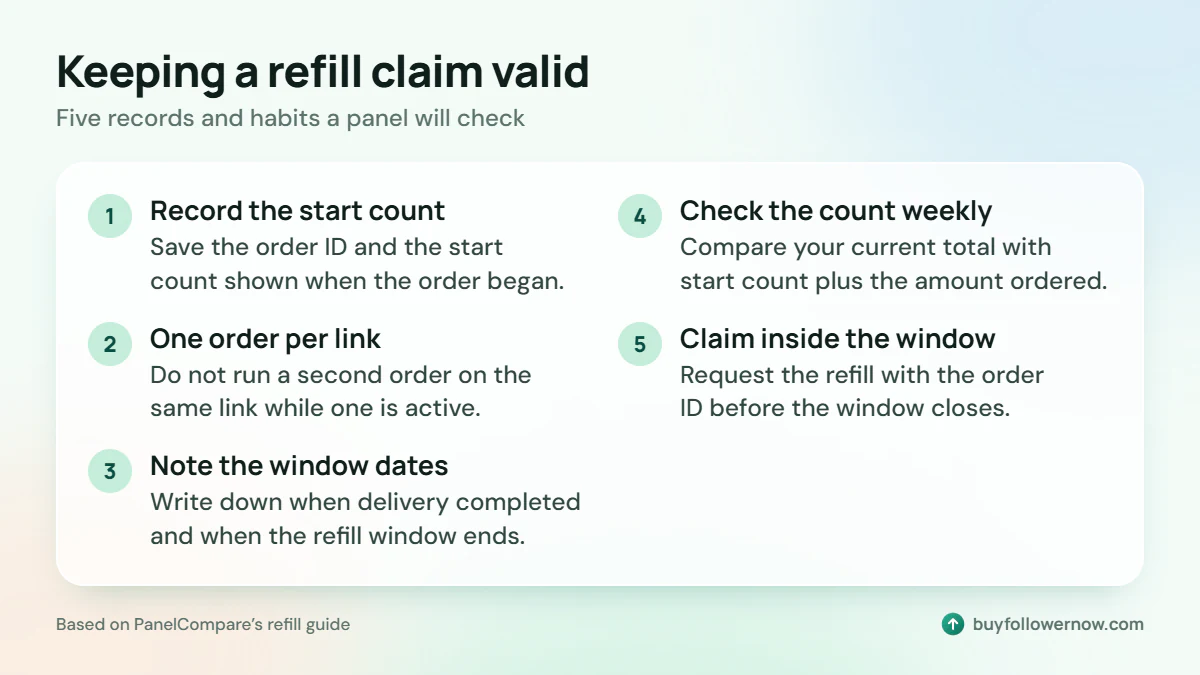
Keep the records the panel will check, and never give it a reason to call the baseline unclear. These steps follow how claims are checked against the start count.
- Record the order ID, the start count and the date delivery completed.
- Run only one order per link at a time; if you want more, raise the quantity on a single order.
- Write down the date the refill window ends.
- Check your counter against start count plus the amount ordered, not against your current total.
- Request the refill with the order ID before the window closes, and keep the request reference.
- If the panel refuses, ask which rule it applied and compare it with the terms written on the service row.
If you are starting out on TikTok, a small first step such as our free TikTok followers lets you watch how the counter behaves over a couple of weeks, which tells you more than any label on an offer.
What none of these promises can do
No label makes followers permanent, and a refill replaces drops after the fact rather than preventing them. Keep these limits in mind before you rely on any durability promise.
- Prices move daily. The figures above are a snapshot from 4 November 2026, not a quote, and a row you see later may differ.
- Drops happen with free and paid followers. A refill only works inside its window and only while the service and the panel still exist.
- Platforms prohibit inauthentic activity. Instagram and TikTok can remove followers they consider fake and can restrict accounts involved, whatever the seller promised.
- For commercial use in the United States, the FTC rule at 16 CFR 465.8 makes it unlawful to buy or sell fake indicators of social media influence that are used to misrepresent influence for a commercial purpose.
- A follower count is not reach. Followers that do not watch, like or comment add little to how a platform distributes your posts.